
Profiling numeracy literacy among ninth-grade students: Empirical evidence from junior secondary education
##plugins.themes.bootstrap3.article.sidebar##
##plugins.themes.bootstrap3.article.main##
Abstract
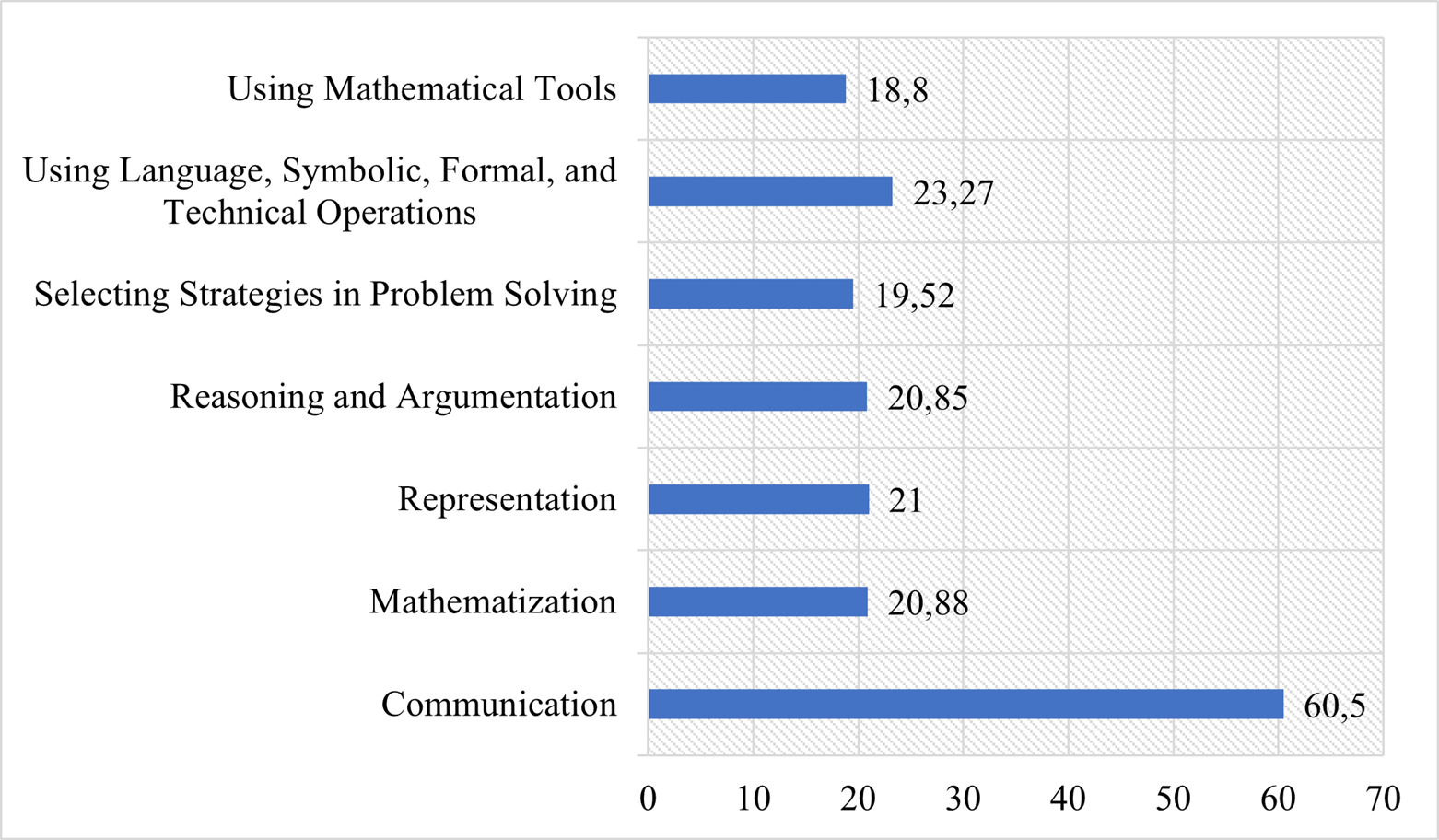
Numeracy literacy in this study refers to students' capacity to interpret quantitative information in context, mathematize situations, use representations, justify their reasoning, select strategies, and employ symbols and tools to support defensible decisions. To address Indonesia's low performance on PISA tasks, we developed an operational profile of 9th-grade students using OECD indicators adapted to the Indonesian junior high school geometry curriculum through Candi Jiwa-based items. Using a descriptive qualitative design with quantitative support, we administered seven open-ended geometry problems to students in Karawang, Purwakarta, and Subang. Test scores were summarized to classify achievement levels. At the same time, classroom observations and semi-structured interviews with students and teachers were used to diagnose reasoning and strategy tendencies and recurring error patterns. Results show that 85.71% of students scored below 60 (low), 14.28% scored 60–80 (medium), and none exceeded 80 (high). Students' strongest area was written communication, mainly descriptive or procedural (restating givens and listing steps). Weaknesses clustered in mathematization, reasoning and argumentation, representation, strategy selection, and use of formal symbols and mathematical tools, indicating procedural competence with limited transfer to contextual modeling. Candi Jiwa serves as a place-based anchor that can lower entry barriers and guide culturally grounded, cognitively manageable task design aligned with OECD processes.
##plugins.themes.bootstrap3.article.details##

This work is licensed under a Creative Commons Attribution-ShareAlike 4.0 International License.
The author is responsible for acquiring the permission(s) to reproduce any copyrighted figures, tables, data, or text that are being used in the submitted paper. Authors should note that text quotations of more than 250 words from a published or copyrighted work will require grant of permission from the original publisher to reprint. The written permission letter(s) must be submitted together with the manuscript.References
Alenezi, M., Wardat, S., & Akour, M. (2023). The need of integrating digital education in higher education: Challenges and opportunities. Sustainability, 15(6), 4782. https://doi.org/10.3390/su15064782
Amalina, I. K., & Vidákovich, T. (2023). Cognitive and socioeconomic factors that influence the mathematical problem-solving skills of students. Heliyon, 9(9), e19539. https://doi.org/10.1016/j.heliyon.2023.e19539
Antoro, B. (2018). Gerakan literasi sekolah dari pucuk hingga akar: Sebuah refleksi [School literacy movement from top to bottom: A reflection]. Direktorat Jenderal Pendidikan Dasar dan Menengah, Kementerian Pendidikan.
Ardoin, N. M., Bowers, A. W., & Wheaton, M. (2022). Leveraging collective action and environmental literacy to address complex sustainability challenges. Ambio, 52(1), 30–44. https://doi.org/10.1007/s13280-022-01764-6
Armellini, A., Antunes, V. T., & Howe, R. (2021). Student perspectives on learning experiences in a higher education active blended learning context. TechTrends, 65(4), 433–443. https://doi.org/10.1007/s11528-021-00593-w
Asmara, A. S., Waluya, S. B., Suyitno, H., Junaedi, I., & Ardiyanti, Y. (2024). Developing patterns of students' mathematical literacy processes: Insights from cognitive load theory and design-based research. Infinity Journal, 13(1), 197–214. https://doi.org/10.22460/infinity.v13i1.p197-214
Bekker, C. I., Rothmann, S., & Kloppers, M. M. (2022). The happy learner: Effects of academic boredom, burnout, and engagement. Frontiers in psychology, 13, 974486. https://doi.org/10.3389/fpsyg.2022.974486
Creswell, J. W., & Creswell, J. D. (2017). Research design: Qualitative, quantitative, and mixed methods approaches. Sage publications.
Dewantara, A. H., Setiawati, F. A., & Saraswati, S. (2023). Towards numeracy literacy development: A single-case study on the use of the living book homeschooling model. Infinity Journal, 12(2), 225–242. https://doi.org/10.22460/infinity.v12i2.p225-242
Fauzan, A., Harisman, Y., Yerizon, Y., Suherman, S., Tasman, F., Nisa, S., Sumarwati, S., Hafizatunnisa, H., & Syaputra, H. (2024). Realistic mathematics education (RME) to improve literacy and numeracy skills of elementary school students based on teachers’ experience. Infinity Journal, 13(2), 301–316. https://doi.org/10.22460/infinity.v13i2.p301-316
Forsblom, L., Pekrun, R., Loderer, K., & Peixoto, F. (2022). Cognitive appraisals, achievement emotions, and students’ math achievement: A longitudinal analysis. Journal of educational psychology, 114(2), 346–367. https://doi.org/10.1037/edu0000671
Grotlüschen, A., Desjardins, R., & Liu, H. (2020). Literacy and numeracy: Global and comparative perspectives. International Review of Education, 66(2-3), 127–137. https://doi.org/10.1007/s11159-020-09854-x
Heilporn, G., Lakhal, S., & Bélisle, M. (2021). An examination of teachers’ strategies to foster student engagement in blended learning in higher education. International Journal of Educational Technology in Higher Education, 18(1), 25. https://doi.org/10.1186/s41239-021-00260-3
Jiang, T., & Li, S. (2023). Secondary school students’ use and perceptions of textbooks in mathematics learning: A large-scale investigation in China. Frontiers in psychology, 14, 1132184. https://doi.org/10.3389/fpsyg.2023.1132184
Kolar, V. M., & Hodnik, T. (2021). Mathematical literacy from the perspective of solving contextual problems. European Journal of Educational Research, 10(1), 467–483. https://doi.org/10.12973/eu-jer.10.1.467
Krstić, M., Filipe, J. A., & Chavaglia, J. (2020). Higher education as a determinant of the competitiveness and sustainable development of an economy. Sustainability, 12(16), 6607. https://doi.org/10.3390/su12166607
Larasati, I., Pramasdyahsari, A. S., & Harun, L. (2025). Enhancing elementary student’s numeracy skills through ethnomathematics-based learning: An analysis of minimum competency assessment results. Journal of Honai Math, 8(1), 71–88. https://doi.org/10.30862/jhm.v8i1.861
Lester, J., Goodman, N., & O'Reilly, M. (2021). Introduction to special issue: Diverse approaches to qualitative data analysis for applied research. The Qualitative Report, 26(6), 1989–1995. https://doi.org/10.46743/2160-3715/2021.5015
Ling, A. N. B., & Mahmud, M. S. (2023). Challenges of teachers when teaching sentence-based mathematics problem-solving skills. Frontiers in psychology, 13, 1074202. https://doi.org/10.3389/fpsyg.2022.1074202
Loyens, S. M. M., van Meerten, J. E., Schaap, L., & Wijnia, L. (2023). Situating higher-order, critical, and critical-analytic thinking in problem- and project-based learning environments: A systematic review. Educational Psychology Review, 35(2), 39. https://doi.org/10.1007/s10648-023-09757-x
Lukito, A., & Madzkiyah, A. F. (2025). Students’ critical thinking dispositions in view of cognitive styles: Exhibiting confidence in reasoning and inquisitive. Perspectives of Science and Education, 73(1), 583–594. https://doi.org/10.32744/pse.2025.1.37
Luscombe, A., & Duncan, J. (2023). Access to information research in the digital era. Canadian Public Administration, 66(2), 268–276. https://doi.org/10.1111/capa.12518
Mahmud, M. R., & Pratiwi, I. M. (2019). Literasi numerasi siswa dalam pemecahan masalah tidak terstruktur. KALAMATIKA Jurnal Pendidikan Matematika, 4(1), 69–88. https://doi.org/10.22236/KALAMATIKA.vol4no1.2019pp69-88
Memon, M. A., Thurasamy, R., Ting, H., & Cheah, J.-H. (2024). Purposive sampling: A review and guidelines for quantitative research. Journal of Applied Structural Equation Modeling, 9(1), 1–23. https://doi.org/10.47263/jasem.9(1)01
Muñez, D., Bull, R., Lee, K., & Ruiz, C. (2023). Heterogeneity in children at risk of math learning difficulties. Child development, 94(4), 1033–1048. https://doi.org/10.1111/cdev.13918
Muniasari, N., Lovelly, D. E., Anisah, A., & Asman, N. (2024). Strategies for developing numeracy literacy in junior high schools in Indonesia: A literature review. LITERACY : International Scientific Journals of Social, Education, Humanities, 3(1), 1–9.
Nufus, H., Muhandaz, R., Hasanuddin, Nurdin, E., Ariawan, R., Fineldi, R. J., Hayati, I. R., & Situmorang, D. D. B. (2024). Analyzing the students’ mathematical creative thinking ability in terms of self-regulated learning: How do we find what we are looking for? Heliyon, 10(3), e24871. https://doi.org/10.1016/j.heliyon.2024.e24871
OECD. (2012). PISA 2012 assessment and analytical framework: Mathematics, reading, science, problem solving and financial literacy. OECD Publishing. https://doi.org/10.1787/9789264190511-en
OECD. (2023). PISA 2022 results (Volume I): The state of learning and equity in education. OECD Publishing. https://doi.org/10.1787/53f23881-en
Ouyang, X., Zhang, X., Räsänen, P., Koponen, T., & Lerkkanen, M.-K. (2023). Subtypes of mathematical learning disability and their antecedents: A cognitive diagnostic approach. Child development, 94(3), 633–647. https://doi.org/10.1111/cdev.13884
Pasquinelli, E., & Richard, O. (2023). Critical thinking as the ability to sort and qualify the information available, to form one's own judgement. European Journal of education, 58(3), 422–433. https://doi.org/10.1111/ejed.12565
Pepin, B., & Haggarty, L. (2001). Mathematics textbooks and their use in English, French and German classrooms. Zdm, 33(5), 158–175. https://doi.org/10.1007/bf02656616
Peterson‐Salahuddin, C. (2024). From information access to production: New perspectives on addressing information inequity in our digital information ecosystem. Journal of the Association for Information Science and Technology, 75(10), 1134–1151. https://doi.org/10.1002/asi.24879
Ramírez-Montoya, M. S., Castillo-Martínez, I. M., Sanabria-Z, J., & Miranda, J. (2022). Complex thinking in the framework of education 4.0 and open onnovation—A systematic literature review. Journal of Open Innovation: Technology, Market, and Complexity, 8(1), 4. https://doi.org/10.3390/joitmc8010004
Reder, S., Gauly, B., & Lechner, C. (2020). Practice makes perfect: Practice engagement theory and the development of adult literacy and numeracy proficiency. International Review of Education, 66(2-3), 267–288. https://doi.org/10.1007/s11159-020-09830-5
Rezat, S. (2010). The utilization of mathematics textbooks as instruments for learning. In V. Durand-Guerrier, S. Soury-Lavergne, & F. Arzarello (Eds.), Proceedings of CERME (Vol. 6, pp. 1260–1269). Institut National de Recherche Pédagogique.
Safitri, D. D., & Effendi, K. N. S. (2022). Kemampuan komunikasi matematis peserta didik SMP pada materi bangun ruang sisi datar [Mathematical communication skills of junior high school students on the material of flat-sided spatial figures]. Jurnal Lemma, 8(2), 99–114. https://doi.org/10.22202/jl.2022.v8i2.5606
Saha, M., Islam, S., Akhi, A. A., & Saha, G. (2024). Factors affecting success and failure in higher education mathematics: Students' and teachers’ perspectives. Heliyon, 10(7), e29173. https://doi.org/10.1016/j.heliyon.2024.e29173
Sayehvand, Z., Alami, F., & SalimiNamin, S. (2025). Exploring actions of teacherpreneurs in education: insights from a qualitative study. Education + Training, 67(7-8), 821–839. https://doi.org/10.1108/et-08-2022-0321
Suherman, S., Vidákovich, T., Mujib, M., Hidayatulloh, H., Andari, T., & Susanti, V. D. (2025). The role of STEM teaching in education: An empirical study to enhance creativity and computational thinking. Journal of Intelligence, 13(7), 88. https://doi.org/10.3390/jintelligence13070088
Tabroni, I., Aswita, D., Hardiansyah, A., & Normanita, N. (2022). Peranan model pembelajaran Vygotski untuk meningkatkan literasi numerasi [The role of the Vygotski learning model in increasing numeracy literacy]. Al-Madrasah: Jurnal Pendidikan Madrasah Ibtidaiyah, 6(3), 486–495. https://doi.org/10.35931/am.v6i3.1013
Vuyk, A., Montania, M., & Barrios, L. (2024). Boredom and its perceived impact in adolescents with exceptional mathematical talent: a sequential mixed-methods study in Paraguay. Frontiers in Sociology, 9, 1214878. https://doi.org/10.3389/fsoc.2024.1214878
Wardani, N., & Siregar, T. J. (2023). The development of HOTS (higher-order thinking skills) assessment instrument based on numeration literacy in mathematics for junior high school. Indonesian Journal of Science and Mathematics Education, 6(2), 238–252. https://doi.org/10.24042/ijsme.v6i2.17433
Weinberg, A., Wiesner, E., Benesh, B., & Boester, T. (2012). Undergraduate students' self-reported use of mathematics textbooks. PRIMUS, 22(2), 152–175. https://doi.org/10.1080/10511970.2010.509336
Wen, R., & Dubé, A. K. (2022). A systematic review of secondary students’ attitudes towards mathematics and its relations with mathematics achievement. Journal of Numerical Cognition, 8(2), 295–325. https://doi.org/10.5964/jnc.7937
Wijaya, T. T., Hidayat, W., Hermita, N., Alim, J. A., & Talib, C. A. (2024). Exploring contributing factors to PISA 2022 mathematics achievement: Insights from Indonesian teachers. Infinity Journal, 13(1), 139–156. https://doi.org/10.22460/infinity.v13i1.p139-156
Wilkins, J. L. M., Jones, B. D., & Rakes, L. (2021). Students’ class perceptions and ratings of instruction: Variability across undergraduate mathematics courses. Frontiers in psychology, 12, 576282. https://doi.org/10.3389/fpsyg.2021.576282
Xie, J. (2021). The effects of boredom on EFL learners' engagement. Frontiers in psychology, 12, 743313. https://doi.org/10.3389/fpsyg.2021.743313
Yekti, S. M. P., & Mufarrihah, I. (2022). Analisis kemampuan literasi numerasi siswa pada tingkat sekolah dasar [Analysis of students' numerical literacy ability at elementary school level]. Journal of Islamic Elementary School, 5(1), 153–160. https://doi.org/10.24256/pijies.v5i1.3753
Yerizon, Y., Arnellis, A., Suherman, S., Arnawa, I. M., Sa'dijah, C., & Anwar, L. (2025). Developing adaptive digital book (ADB) in enhancing students’ numeracy literacy ability. Infinity Journal, 14(3), 571–586. https://doi.org/10.22460/infinity.v14i3.p571-586
Zlatkin-Troitschanskaia, O., Beck, K., Fischer, J., Braunheim, D., Schmidt, S., & Shavelson, R. J. (2020). The role of students’ beliefs when critically reasoning from multiple contradictory sources of information in performance assessments. Frontiers in psychology, 11, 02192. https://doi.org/10.3389/fpsyg.2020.02192